
Building with Hemp Blocks in Aldeburgh: An Architect’s Perspective
A contemporary home, a traditional setting and a commitment to building with lower-carbon materials.
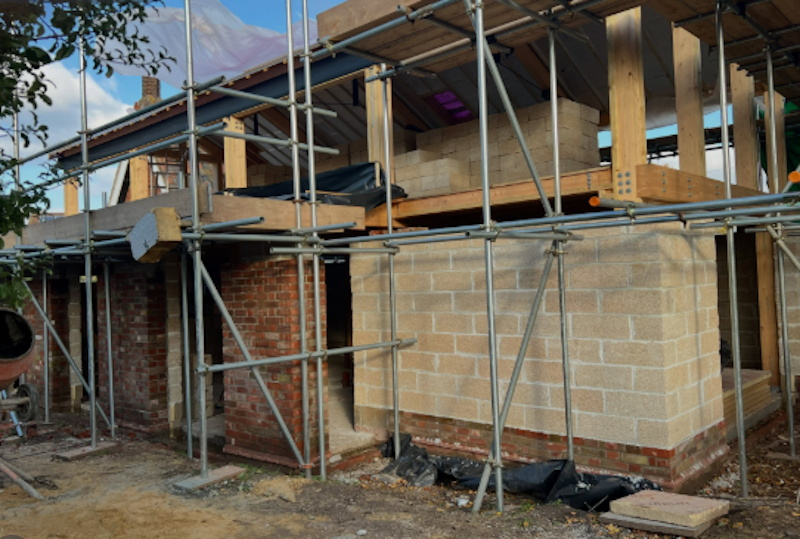
How do you combine contemporary architecture, sustainable construction and the sensitive setting of a historic coastal Suffolk town?
For architect Charles Curry-Hyde of Curry-Hyde LLP, the answer is a new two-storey, three-bedroom home in the heart of Aldeburgh, where hempcrete blocks are playing a central role in delivering a simple, cost-effective and low-carbon building.
Located within the Aldeburgh Conservation Area, the project brings together a contemporary structural design with materials chosen to create a comfortable, durable and environmentally considered home.
Charles first learnt about hemp in construction while studying for his degree in South Africa back in the 1980s. He has spent the last two years working to lower the carbon footprint of his projects in Suffolk. This initiative started with conversations with clients who carefully recycle their waste and wanted to build using significantly more non-recyclable plastic insulation. This project represents an important step in putting that experience and thinking into practice.
Why choose hempcrete blocks?
Charles has been working towards removing plastics from his building specifications, looking for materials that are simple, durable and avoid some of the potential problems associated with conventional alternatives.
Hempcrete blocks offered several advantages.
Having explored wet, cast-in-situ hempcrete, Charles recognised the practical challenges of using this approach locally. Specialist contractors are limited, installation is labour-intensive and drying times can introduce seasonal uncertainty.
Hempcrete blocks offered a more straightforward alternative.
Unlike wet hempcrete, the blocks can be laid throughout the year by conventional bricklayers and blocklayers, without the need for specialist installation contractors.
There were other considerations, too. Charles’s clients enjoy listening to loud music, making the acoustic properties of hempcrete an attractive feature of the specification, along with the fire-resistant properties of hempcrete.
The combination of straightforward installation, durability, acoustic benefits and the opportunity to reduce reliance on plastic-based materials made hempcrete blocks a natural choice for the project.
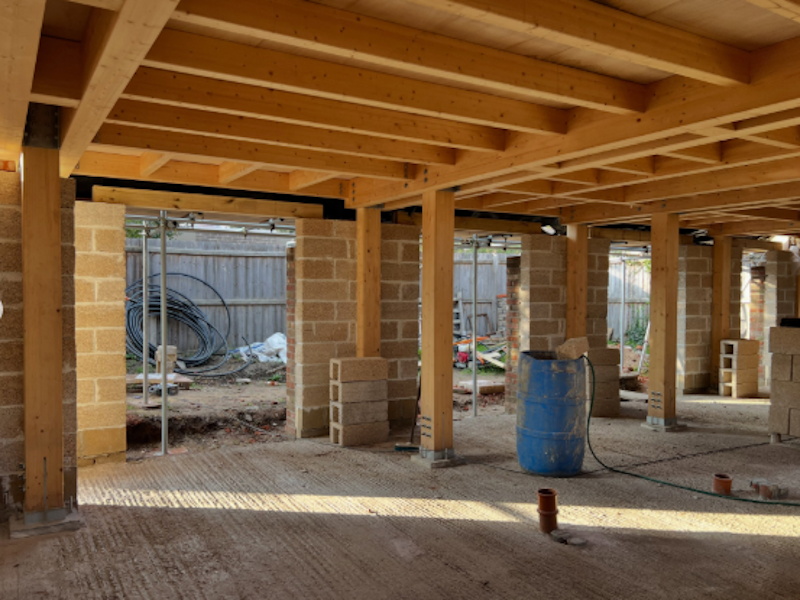
A contemporary structural design
The house is being constructed around a thin-plate glulam frame, arranged on a three-metre grid, with continuous hemp block walls.
Selected external elements will incorporate reused facing bricks, helping the new building sit comfortably alongside the neighbouring listed properties and reflect the character of its historic surroundings.
The result is an interesting combination of contemporary timber engineering and natural building materials, demonstrating the flexibility of hempcrete blocks within a modern architectural design.
LTC Construction Ltd is undertaking the building work, which started on site in April 2026, with completion anticipated in April 2027.
Learning along the way
As with any project exploring a different approach to construction, there have been lessons along the way.
One of the biggest challenges has been getting the costs right.
Charles explains that the initial quantity surveyor and builder’s cost plan included a rate more than twice the figure that was ultimately agreed. For many clients, this sort of cost uncertainty could have resulted in a change of specification, potentially reverting to conventional timber frame and PIR insulation.
However, through further work and collaboration, the project has been able to retain its hemp block specification.
The foundations and lower wall construction have also presented challenges. Finding a suitable combination of lower-carbon materials below the hemp block walls proved difficult, resulting in a conventional PIR-insulated raft foundation and concrete block dwarf wall.
Charles continues to explore prefabricated alternatives that could offer a lower-carbon solution for future projects.
Another important consideration has been achieving an effective airtight connection between the hemp walls and roof construction. With the roof design constrained by the available building height, careful detailing and planning have been essential.
And one practical lesson stands out: the importance of having a scaffold roof to help protect the construction process from the elements.
Collaboration makes a difference
Charles is keen to acknowledge the support received while developing the material specification and progressing the project.
Neil Stephen at The Hemp Block Company and Andrew Neal at Unity Lime have both provided valuable guidance on the practicalities and technical considerations of building with hemp.
For an architect investing considerable time in developing a lower-carbon approach to construction, having access to knowledgeable suppliers and technical support has been an important part of getting the project to this stage.
A better way to build?
Ultimately, the ambition for the Aldeburgh project is refreshingly straightforward: to create a cost-effective, low-carbon home that is comfortable to live in.
It is also a good example of how hempcrete blocks can be incorporated into contemporary residential architecture, offering architects and designers another option when looking to reduce the environmental impact of new buildings.
For Charles Curry-Hyde, the project brings together decades of interest in hemp construction with a practical, modern approach to building.
And as the house moves towards completion, it will provide another valuable example of how natural materials can contribute to the future of sustainable housing.
Project details
- Project: New three-bedroom, two-storey infill house
- Location: Aldeburgh, Suffolk
- Architect: Charles Curry-Hyde, Curry-Hyde LLP
- Builder: LTC Construction Ltd
- Structural system: Thin-plate glulam frame on a three-metre grid
- Wall construction: Continuous hempcrete block walls
- Construction started: April 2026
- Anticipated completion: April 2027
- Key materials: Hempcrete blocks, glulam and reused facing bricks
The Hemp Block Company would like to thank Charles Curry-Hyde for sharing his experience and insight into this project.


