
How Much Does It Cost to Build a Hempcrete House?
Building a house with hempcrete blocks is about more than choosing a sustainable building material. It’s about finding a smarter, more efficient way to build.
For self-builders, homeowners, architects and developers, the cost of construction is always a major consideration. But when comparing building methods, looking solely at the price of individual materials rarely tells the whole story.
Hemp blocks offer a practical alternative to standard construction methods, combining natural insulation, straightforward installation and excellent thermal performance. They arrive manufactured and pre-cured, ready to build with, helping to simplify the construction process and reduce some of the delays associated with more traditional hempcrete techniques.
Think of them as “Lego for adults”. Blocks are laid using a natural lime 10mm mortar bed, making construction similar to standard construction and allowing work to progress to subsequent stages without waiting for wet hempcrete walls to dry out.
So, what does it really cost to build with hemp blocks, and where can the savings be made?
1. Hemp Block Material Costs: What Should You Budget?
The starting point is the cost of the blocks themselves. Unlike standard aggregate or aerated concrete blocks, hempcrete blocks are generally supplied by the pallet, with prices calculated according to the square metres covered and the thickness selected.
The right thickness will depend on the application, the building design and the thermal performance required.
For external walls in new-build properties, blocks between 300mm and 400mm are commonly considered, depending on the overall wall specification.
The following table provides an indicative guide to hemp block material costs:
| Block thickness | Typical application | Approx. material cost per m² |
| 80mm–140mm | Internal partition walls / retrofit internal insulation | £28–£50 |
| 250mm | Extensions / deep retrofits / frame infill | £82–£90 |
| 300mm | New-build external walls | £99–£115 |
| 360mm–400mm | High-performance / low-energy homes | £118–£156 |
Prices are indicative, excluding VAT and delivery. Actual costs will depend on the products selected and project requirements.
Don’t forget the mortar. Hemp blocks require a compatible natural lime mortar rather than standard cement mortar. Allow approximately £5–£10 per m² for this additional material, depending on the specification and coverage.
You can explore the different sizes, specifications and prices on our Hempcrete Blocks product page.
2. Installation Costs: Where Hemp Blocks Can Make a Difference
The cost of building a hempcrete house shouldn’t be judged on material prices alone. Labour, installation time and the wider construction programme can all have a significant impact on the final budget.
This is where hemp blocks offer some important practical advantages.
Unlike cast-in-situ hempcrete, which involves mixing and placing wet material into temporary shuttering, hemp blocks arrive ready to lay. There is no requirement to construct extensive shuttering or undertake the same wet mixing and compaction processes on site.
Their manageable size and weight also make them relatively easy to handle, with no specialist machinery or complicated installation equipment generally required.
For builders and contractors, this can mean:
- Quicker installation: A straightforward block-laying process helps maintain construction progress.
- Reduced labour requirements: Less complicated installation can help reduce the labour involved compared with more labour-intensive hempcrete methods.
- Fewer construction delays: Pre-cured blocks avoid the extended wall-drying periods associated with cast-in-situ hempcrete.
- Simpler site logistics: Blocks arrive ready to use, helping to make storage, handling and installation more manageable.
The result is a building system that can help reduce installation time and improve the efficiency of the overall construction programme.
3. Understanding the Structural Requirements
One important consideration when planning a hemp block build is understanding how the walls work structurally.
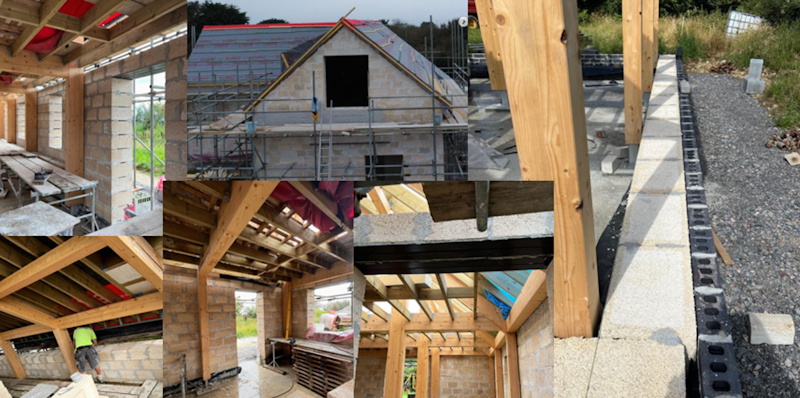
Hempcrete blocks are generally used as non-load-bearing insulation infill, rather than as a replacement for the building’s primary structural system. They provide the wall construction and thermal envelope, while the supporting frame carries the weight of the roof and floors.
The primary frame
A structural frame must be established as part of the building design. In the UK, this is commonly constructed using timber, although steel and engineered glulam frames are also suitable options.
Wrapping or infilling the frame
There are two principal approaches to incorporating hemp blocks into the structure:
- Frame infill: Blocks are built between the structural timber studs or frame members.
- External wrapping: Blocks are installed around the outside of the structural portal frame, creating a continuous layer of insulation.


